Try something before you read on. Without opening your calendar, your commits or your old messages, name five things you did at work this year that you’re proud of.
If you got stuck after two, you’re not alone. And you’re probably not unproductive either. You just have a very human memory, and it’s quietly lying to you about your year.
It’s November. Performance reviews are coming, salary conversations, “so what are your goals for next year?” And right when you need to remember your best work, your brain hands you a highlight reel of everything that went wrong.
Your memory keeps the bugs, not the fixes
Psychologists have a blunt name for this: bad is stronger than good. In a well-known review of research across many areas of life, Roy Baumeister and his colleagues found that negative events, feelings and feedback consistently hit us harder than positive ones. They found almost no exceptions.
For developers, it looks like this. You remember the production bug in March in high definition. You remember the code review comment that stung. You remember the sprint where nothing worked.
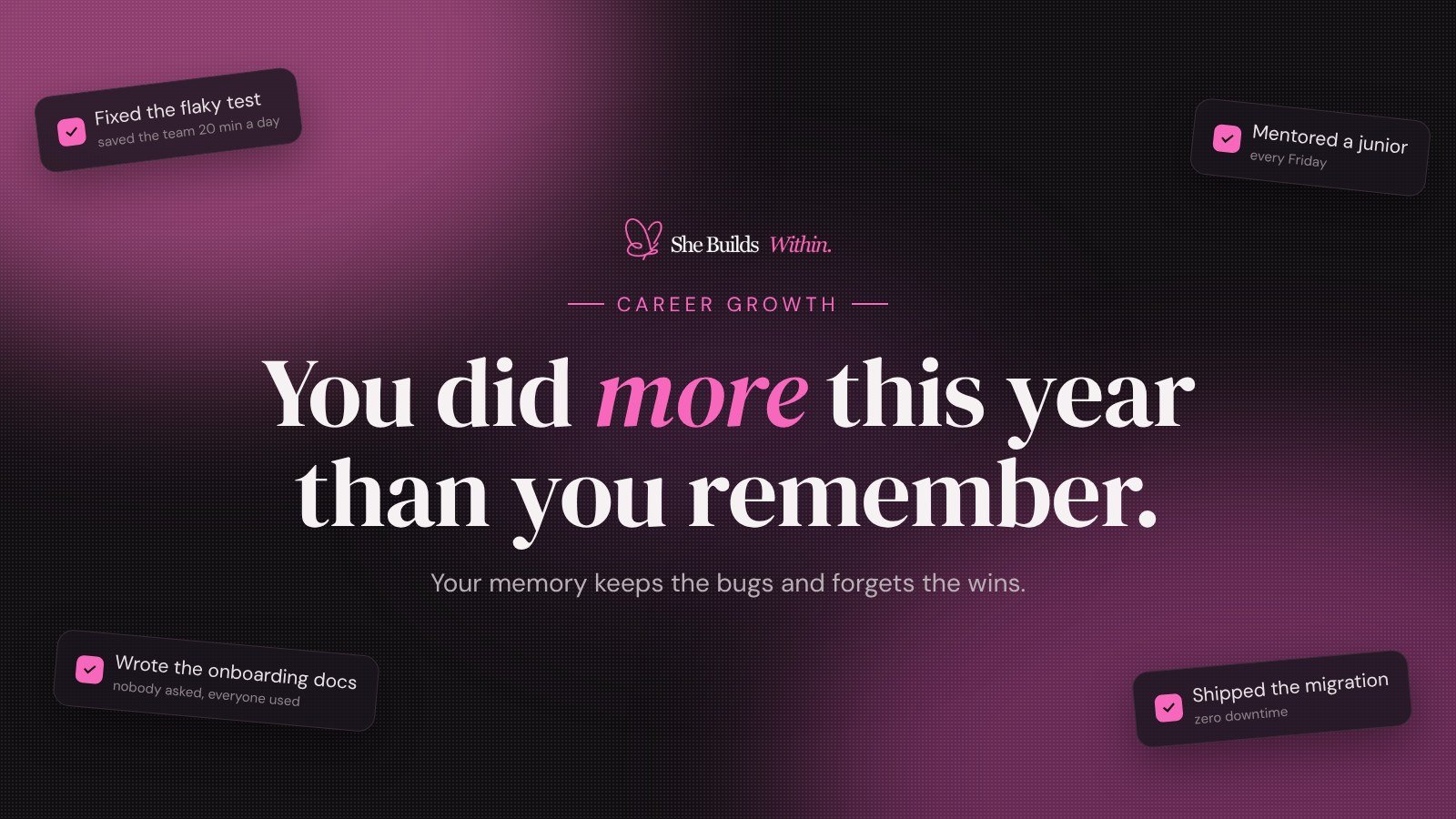
But the migration you planned so well that nobody noticed it happened? The junior you helped every week? The flaky test you finally fixed, which saved your team twenty minutes a day? Those faded almost immediately. Good work that goes smoothly is invisible, even to the person who did it.
The uncomfortable truth
If you don’t remember your wins, nobody else will. Not because people don’t care, but because everyone is busy remembering their own bugs.
Small wins matter more than you think
Teresa Amabile and Steven Kramer studied almost 12,000 daily diary entries from 238 professionals. Their finding, which they called the progress principle, was simple: the best workdays were the days people felt they made progress on meaningful work. Even small wins had almost as much effect on how people felt as big breakthroughs.
The same research showed the other side too. Setbacks had two to three times more impact on people’s feelings than progress did. So the small wins are real, they matter, and they’re also the first thing we forget.
That’s why “I didn’t do much this year” is so often wrong. You did. You just didn’t write it down.
Meet the brag document
Engineer and writer Julia Evans popularised a simple fix in her essay “Get your work recognized: write a brag document”. The idea: keep one running document of what you’ve done. Not a polished CV, just a list you add to as you go.
Her reasons are the ones most of us need to hear. You don’t remember everything you did. Your manager doesn’t either. And the point isn’t to exaggerate. In her words, you just make your work sound exactly as good as it is.
If the word “brag” makes you uncomfortable, call it something else. A wins file, a work journal, a “done list”. The name doesn’t matter. The habit does.
What actually goes in it
Most people only write down the big, shiny projects. Those count, but they’re maybe a third of your real work. Here’s what else belongs there:
- Projects and their impact Not just “built the dashboard”, but what changed because of it. Faster? Fewer support tickets? Fewer late-night pings?
- The fuzzy work Evans calls it that: work that’s hard to measure. Code reviews, onboarding someone, writing the docs nobody wanted to write, calming a stressful meeting. This is often the work that makes you senior.
- What you learned A new language, a framework, a hard lesson from a failed release. Growth is a result too.
- Collaboration and help Who did you unblock? Who did you mentor? Who thanked you, even in a small Slack message?
- Outside your job title Side projects, open source, a blog post, a talk, a community you show up for.
How to rebuild a year you don’t remember
You don’t need to start in January. You can rebuild this year in one evening. Try this:
- Go through your calendar month by month. Meetings remind you of projects, launches and people you helped.
- Scroll your merged pull requests and closed tickets. You’ll be surprised how much is there.
- Search your messages for “thank you”. Gratitude leaves a trail. Screenshot the good ones.
- Write one win per month. Even a small one. Twelve lines are enough to change how you see your year.
- Add a number where you can. Minutes saved, bugs fixed, users helped, pages shipped. Honest estimates are fine.
From list to sentence
A brag document becomes powerful when you can turn its lines into sentences you can say out loud. In a review, a salary conversation or an interview, try this simple formula:
I [did something] for [someone], which [changed something], and here’s how I know.
“I rebuilt the onboarding docs for new developers, which cut their setup time from two days to half a day. Two people told me it was the first time setup just worked.” That’s not bragging. That’s information.
A note for the people who always feel behind
If you’re new to tech, switching careers, working in a second language or rebuilding after a hard year, this matters even more. When you feel behind, your brain collects evidence that you’re behind. A wins list is evidence for the other side.
Read it on the bad days. It won’t fix everything, but it will remind you that you’ve been building the whole time, even when it didn’t feel like it.
Start tonight
Open a blank note. Write three things you did this year that you’re quietly proud of. Then add one every Friday. That’s the whole habit.
Want a head start? I made a free Year in Wins template: month-by-month prompts, a brag doc structure and a page that turns your wins into review-ready sentences. Get it free on the Resources page, and if this essay helped, you can buy me a coffee.
Sources & further reading
- “Get your work recognized: write a brag document”, Julia Evans, June 2019: why and how to keep a brag document, with a template.
- “The Progress Principle”, Teresa Amabile & Steven Kramer, Harvard Business School Working Knowledge: research on small wins, based on about 12,000 diary entries.
- “Bad Is Stronger Than Good”, Baumeister, Bratslavsky, Finkenauer & Vohs, Review of General Psychology, 2001: why negative events affect us more than positive ones.
· · ·