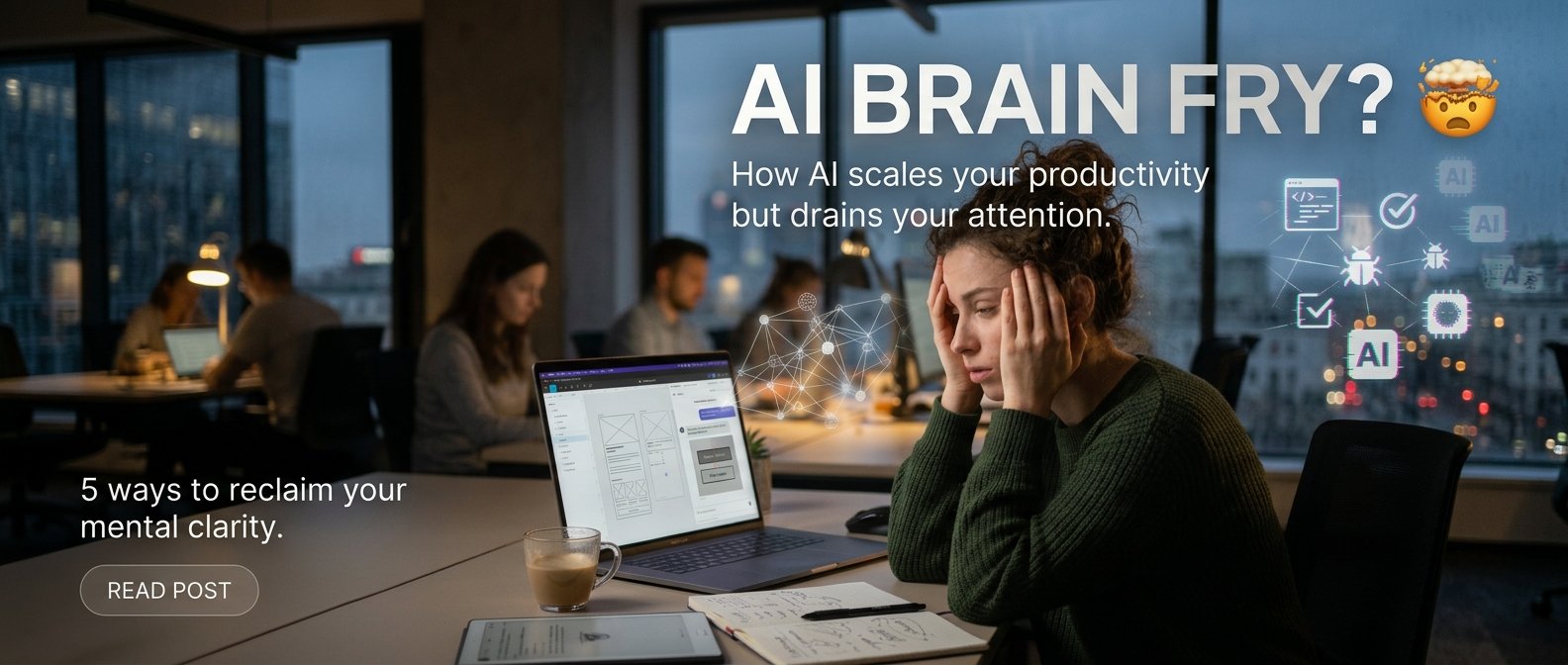
I noticed it in myself before I could explain it. AI was supposed to be the thing that took work off my plate. And it did, on paper. Components I used to build in an afternoon took twenty minutes. Boilerplate disappeared. Bugs got a second pair of eyes in seconds.
But by 3 p.m. I couldn’t hold a single thought long enough to finish it. I wasn’t overworked in the old sense. I was tired in a way I didn’t have a word for yet.
The paradox nobody planned for
It turns out I’m not the only one. Earlier this year, Boston Consulting Group surveyed 1,488 professionals and gave this feeling a name: AI brain fry, the mental exhaustion that comes from using or supervising AI tools beyond what our minds can comfortably handle. Interestingly, the same research found that burnout went down when AI took over repetitive tasks. The tools themselves aren’t the problem. The way we’re using them is.
Simon Willison, co-creator of Django and one of the most thoughtful voices on AI-assisted coding, described on Lenny’s Podcast running several coding agents in parallel: his work moved faster, and he was mentally exhausted by mid-morning.
Faster tools. More tired brains. Both things are true at once, and pretending only the first one exists is how we burn out quietly.
Why reviewing is harder than writing
When you write code yourself, your brain builds the context as you go. Each line follows the last one. You know why the function looks the way it does because you made every small decision that shaped it. That’s what flow feels like.
When AI writes the code, your role shifts from author to inspector. And inspecting is a different kind of work:
- Decision density goes up.Instead of making one decision every few minutes, you’re making dozens per hour: accept, reject, tweak, regenerate, check the edge case, check it again. Every one of them draws from the same limited pool of attention.
- You review code you never thought through.Reading someone else’s solution means rebuilding their reasoning from scratch. With AI, there is no “someone” to ask. You carry the full weight of understanding it, and the full responsibility if it breaks.
- Speed quietly raises the bar.When a task takes twenty minutes instead of three hours, nobody gives you the remaining two hours and forty minutes back. The freed-up time gets filled with more tasks, more agents, more output to check.
“AI didn’t remove the hard part of my job. It removed the restful part.”
The cost we don’t measure
We measure velocity obsessively: tickets closed, PRs merged, lines shipped. We almost never measure cognitive load. So the dashboard says you’re having your best month, while your brain says you’re running on fumes.
And that gap matters. Tired reviewers miss things. The bug you would have caught at 10 a.m. slips through at 4 p.m. because you approved the fifth suggestion in a row without really reading it. The tool that was supposed to make the work better slowly makes it more fragile, simply because the human in the loop is depleted.
This isn’t an argument against AI. I use it every day, and I don’t want to go back. It’s an argument for treating your attention like the scarce resource it actually is.
Boundaries that work with your brain
Here is what has helped me stop ending the day fried. None of it is complicated. All of it is intentional.
Five boundaries for the AI-assisted workday
- One agent at a time. Parallel agents look efficient, but your attention isn’t parallel. Run one, review it properly, then start the next.
- Think first, generate second. For hard problems, sketch the solution yourself before you prompt. You’ll review faster because you already know what “right” looks like.
- Batch your reviews. Instead of checking output every few minutes, set two or three review windows a day and protect the time in between for deeper work.
- Keep one manual block. One hour a day of writing code (or docs, or CSS) entirely yourself. It keeps your skills sharp and gives your brain the flow it’s missing.
- Shut down on purpose. End the day by writing down what’s open and what’s next. An unfinished loop in your head is still work, even after you close the laptop.
Slower on purpose
The developers who will do well over the next few years won’t be the ones who generate the most code. They’ll be the ones who can still think clearly at the end of the day: who notice the subtle bug, push back on the wrong feature, and make good decisions when everyone else is running on autopilot.
That kind of clarity doesn’t come from more tools. It comes from fewer priorities and better boundaries. If you want a simple structure for that, the free She Builds Within Notion Planner is built around a maximum of three weekly priorities, so the speed AI gives you goes into what matters instead of into more noise.
“Your output can scale. Your attention can’t. Plan for the one that doesn’t.”
If this essay helped you name something you’ve been feeling, consider buying me a coffee. It helps me keep writing about the human side of building software.
Have you noticed this kind of tiredness since AI became part of your workflow? What helps you protect your focus? Share your experience in the comments or connect with me on LinkedIn.
Sources & further reading
- “Life with AI causing human brain ‘fry’”, The Star / AFP, March 2026: on Boston Consulting Group’s study of 1,488 U.S. professionals and the term “AI brain fry”.
- “Software Engineers Feel Exhausted By AI Agents”, Let’s Data Science, April 2026: Simon Willison on Lenny’s Podcast about mental fatigue from running parallel coding agents.
- “AI-assisted Engineers Face a New Form of Burnout”, Let’s Data Science, 2026.
- “From Coder to Orchestrator”, SoftwareSeni: on the shift from writing code to supervising it.
- “Lost Confidence: The Developer Crisis of Self-Doubt in the AI Coding Era”, Brain Detox, 2026.