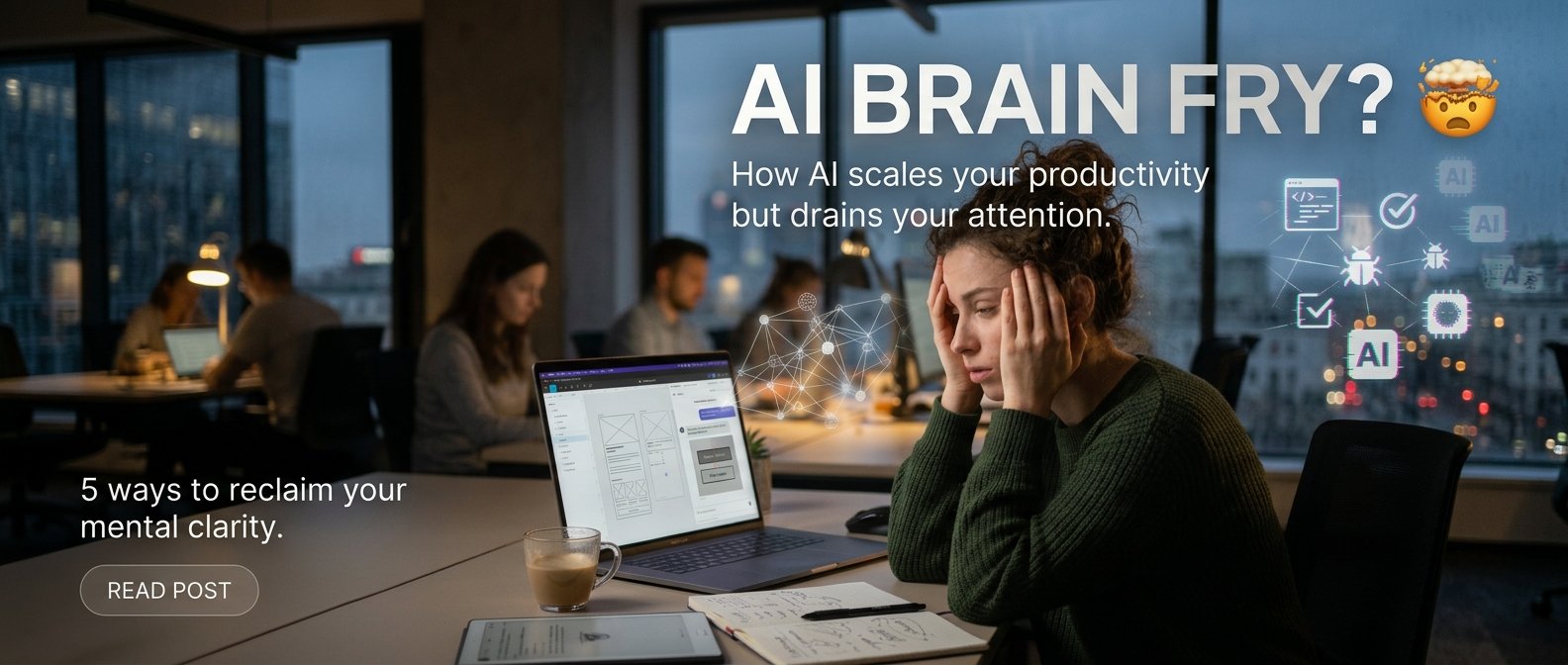
That isn’t a hunch anymore. It’s showing up in the data.
This summer, Lenny’s Newsletter published its second annual survey of how tech workers feel, and the headline wasn’t “AI is good” or “AI is bad.” It was this: the workforce is splitting in two. And the line between the halves isn’t talent, seniority or even how much AI you use. It’s how AI has changed the way you see yourself.
The numbers behind the split
When people were asked how AI has affected their professional identity, almost half, 49%, said it has amplified them. About 27% said it has redefined them. And roughly one in five said it has destabilized or diminished them.
That one answer predicted a lot. People who felt amplified were far more optimistic about their careers and far more likely to recommend their field to someone starting out. The gap between the “amplified” and the “diminished” group was about three times bigger than the gap between founders and everyone else.
Meanwhile, the overall mood got heavier:
- Burnout went up.Significant burnout rose from about 45% in 2025 to nearly 56% in 2026.
- Optimism went down.Fewer than half of respondents now feel optimistic about their careers.
- People wouldn’t recommend their own job.53% would steer a newcomer away from their role.
The 2026 Stack Overflow Developer Survey, with more than 30,000 developers, tells a similar story from another angle: only 22% said they’re happy at work, nearly half described themselves as complacent, and burnout or tech fatigue was the top reason behind it. Two-thirds of developers already use AI coding assistants or agents.
So almost everyone is using the tools. Not everyone is coming out of it whole.
It’s not about who’s smarter
It’s tempting to read this as winners and losers: the adaptable people and the ones who “didn’t keep up.” I don’t think that’s what the data is saying.
The same survey found that 82% of people say AI makes them at least moderately better at their job. Most of the “diminished” half isn’t bad at AI. They’re often good at it. What changed is the story they tell themselves about their work.
If your sense of value was built on writing the code, and now a tool writes the first draft in seconds, it’s natural to feel smaller. If your sense of value was built on solving the problem, the same tool feels like extra hands. Same tool, same output, different identity underneath.
The split in one sentence
AI didn’t divide us by skill. It divided us by what we believe our work is for.
Why the worries are real (and not just in your head)
Feeling destabilized isn’t a mindset failure. The concerns people named are concrete: 51% expect to do more for the same pay, 46% worry about an unsustainable pace, and 41% worry about declining quality. Layoff worry was the strongest single predictor of pessimism in the whole survey.
Those are structural problems, and no journaling exercise fixes a layoff. But inside those conditions, there’s still a part that belongs to you: how you define your role, and what you practice on purpose.
How to move toward the “amplified” half
Not as a performance, and not by pretending everything is fine. Just by shifting what you anchor yourself to.
- Rewrite your job description in your own words.Not “I write React components.” Something like “I turn messy problems into things people can actually use.” The second one survives any tool change.
- Own the judgment, not just the output.Reviewing, deciding, saying “no, not like this” — that’s the part AI can’t carry for you. Make it visible in PRs, standups and your own notes.
- Protect one piece of deep work a week.A problem you solve end to end without shortcuts. It keeps the muscle, and it keeps the feeling that the work is yours.
- Learn in public, a little.Write down what you figured out this week. Confidence grows from evidence, and a list of things you learned is evidence.
- Pick your environment when you can.The survey found well-being drops steadily as company size grows, and people with a genuinely good manager enjoy their work about 65% more. Where you work isn’t everything, but it isn’t nothing.
You can be in both halves
Here’s the part I keep coming back to: most people picked more than five emotions about AI at once. Excited and tired. Curious and scared. Grateful and a bit resentful. Over three quarters chose at least one positive and one negative feeling together.
So maybe the honest answer to “which half are you in?” is both, depending on the day. That’s not a contradiction. That’s what it looks like to be a person in the middle of a big change.
The goal isn’t to never feel diminished. It’s to notice when you do, and to come back to the version of your work that’s bigger than any single tool: the thinking, the care, the judgment, the choices only you can make.
If planning that shift feels like one more thing on your list, the free Monthly & Weekly Focus Notion planner on the Resources page is built for exactly this: one clear direction, three priorities a week, and a monthly look at what actually moved.
Which half do you feel closer to right now — and what changed it? Share it in the reflections below or tell me on LinkedIn. I read every one.
Sources & further reading
- “How tech workers are feeling in 2026: a workforce splitting in two”, Lenny’s Newsletter (Noam Segal & Lenny Rachitsky), July 2026: AI identity, burnout, optimism and recommendation data.
- “Here’s What a Survey of 30,903 Professionals Reveals About Work and Burnout”, Entrepreneur, October 2026: summary of the 2026 Stack Overflow Developer Survey on happiness, complacency and AI use.