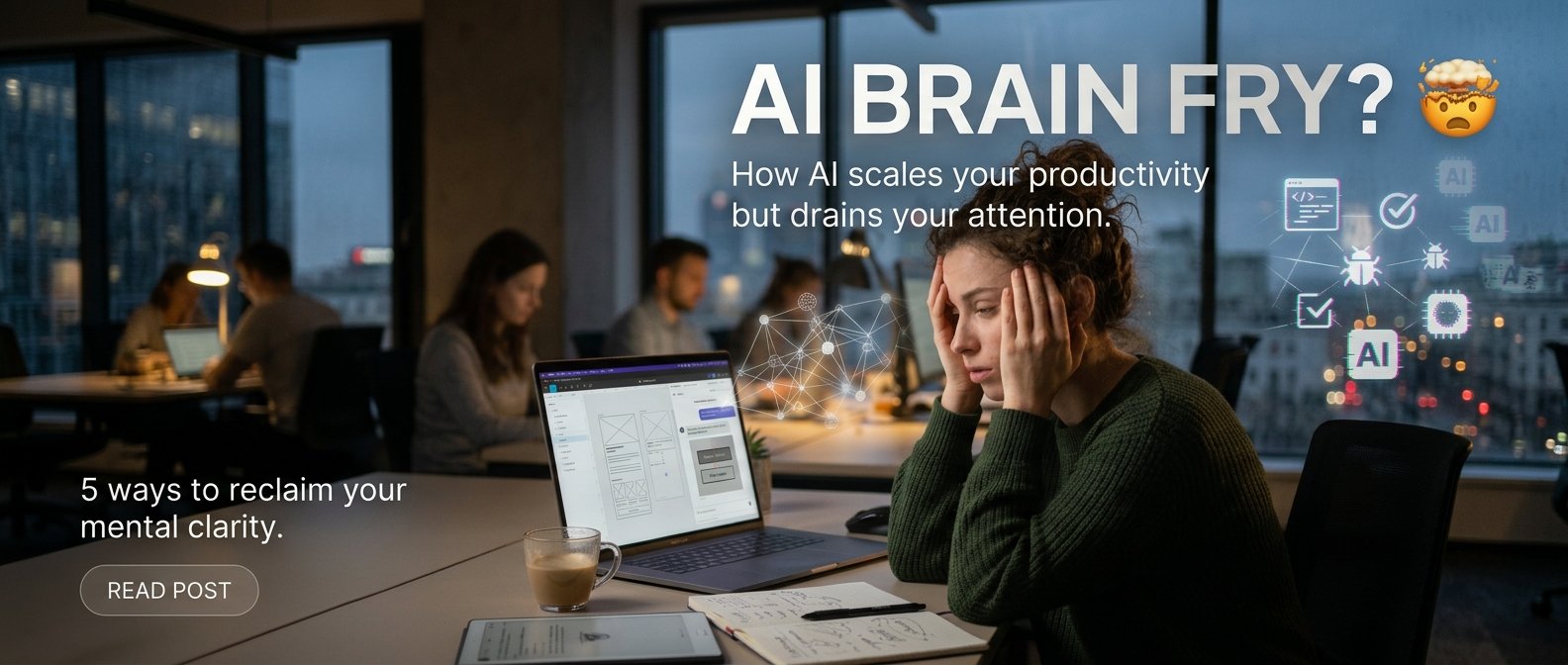
We open an AI chat before we’ve finished reading the ticket. We accept a solution that looks right because checking it feels slower than trusting it. And somewhere along the way, the small voice that used to say “I can figure this out” starts to sound more like “Can I, though?”
We’re shipping more than ever. Many of us feel less sure of ourselves than ever. That gap is worth looking at honestly.
The confidence gap nobody talks about
A recent essay on the developer crisis of self-doubt describes it as two things happening at once: some real skill atrophy, and an identity shift from writing code to reviewing it. Both can make you feel like you’re slowly losing your footing, even while your output goes up.
The numbers point the same way. In the 2025 Stack Overflow Developer Survey, with more than 49,000 respondents, 84% of developers said they use or plan to use AI tools. At the same time, 46% said they don’t trust the accuracy of AI output, up from 31% the year before.
We use it more and trust it less. And when you’re working all day with something you don’t fully trust, it’s easy to stop trusting yourself too.
Why self-confidence is not vanity
Here’s the part I find most interesting. Researchers from Microsoft Research and Carnegie Mellon surveyed 319 knowledge workers who use generative AI every week. They found that confidence in AI was associated with less critical thinking, while self-confidence was associated with more.
In other words: the people who still trust their own judgment are the ones who actually check the AI’s work. The people who don’t trust themselves tend to accept whatever comes back.
So self-confidence isn’t ego. In the AI era, it’s a quality-control system. It’s the thing that makes you pause and ask, “Wait, is this actually right?”
“The developers who check AI’s work are the ones who still trust their own.”
Confidence was never about knowing everything
Part of the problem is that many of us built our confidence on the wrong foundation. We felt confident because we knew things: the syntax, the API, the trick for that one browser bug.
That kind of confidence was always fragile in our field. Frameworks change. Tools change. And now an AI can recall syntax faster than any of us. If your sense of competence lives in what you remember, it will feel threatened every single week.
There’s a more durable kind of confidence, and it sounds different. It isn’t “I know this.” It’s “I know how to figure this out.” It lives in your process: how you break a problem down, how you test an assumption, how you get from confused to clear.
Interestingly, the same Stack Overflow survey found that when developers still turn to a human for help, 61.3% say it’s because they want to fully understand their code. That instinct is the core of real confidence. Not having the answer, but needing to understand it.
Three questions that rebuild process confidence
- Do I understand why this works? Not just that it works, but why.
- Could I debug it if it broke at 5 p.m. on a Friday? If not, you don’t own it yet.
- Could I explain it to a teammate in two minutes? Explaining is the fastest test of understanding.
How to rebuild confidence that lasts
- Think before you prompt.Give yourself five minutes with the problem before you open the chat. Sketch the approach, even roughly. You’ll be surprised how often you were closer than you thought.
- Explain before you merge.Before accepting AI-generated code, describe in a sentence or two what it does and why. If you can’t, that’s your signal to slow down, not a sign that you’re not good enough.
- Practice without the net.Once a week, solve one small task entirely on your own. Not as a purity test, but as training. Skills you never use quietly fade, and confidence fades with them.
- Keep a “figured it out” log.Write down the problems you solved and how. On the days self-doubt gets loud, this becomes evidence, and evidence is much harder to argue with than a feeling.
- Go one layer deeper.If AI handles the surface, spend some time underneath it: how the browser renders, how the database plans a query, how accessibility actually works for real people. Depth is what makes you the person who notices when something is off.
You haven’t lost it. You’ve just stopped practicing it.
If you’ve been feeling less sure of yourself lately, it doesn’t mean you’re a worse developer than you were a year ago. It means the conditions changed, and the way confidence gets built has to change with them.
You don’t need to know everything. You need to trust the way you learn, and give that process enough room to keep working.
If you want a simple place for that, the free She Builds Within Notion Planner includes a monthly review, which works well as a “what did I figure out this month?” check-in.
“Confidence isn’t knowing the answer. It’s trusting yourself to find it.”
If this essay helped you feel a little steadier, consider buying me a coffee. It helps me keep writing about the human side of building software.
Have you noticed your confidence shifting since AI became part of your work? What helps you trust your own judgment again? Share it in the comments or connect with me on LinkedIn.
Sources & further reading
- “Lost Confidence: The Developer Crisis of Self-Doubt in the AI Coding Era”, Brain Detox, June 2026: skill atrophy and the shift from writing to reviewing code.
- “Stack Overflow’s 2025 Developer Survey Reveals Trust in AI at an All Time Low”, Stack Overflow, July 2025: 49,000+ respondents; 84% use or plan to use AI, 46% don’t trust its accuracy.
- “Some workers already let AI do the thinking for them, Microsoft researchers find”, The Register, February 2025: Microsoft Research and Carnegie Mellon study of 319 knowledge workers (CHI 2025).